Showing posts with label history. Show all posts

Tuesday, March 12, 2013

Homeschooling - Making a History Timeline DIY


Believe it or not, that is one segment of a homemade history timeline that our family made during the years we homeschooled the kids (21 years in all!)  The photos below are not in order, and are only a few segments of the timeline, but they give you a general idea of what we did to construct our history timeline.

So why make your own timeline when there are others available for purchase? After all, it's a lot easier to hit the 'Buy Now' button than it is to do the work of actually cutting out pictures and making date tags.


I had seen history timelines that could be purchased, ready to place on a wall. I had also seen timelines that were in book form. BUT it seemed to me that it would be much more helpful to the learning process if we could actually make our own timeline, putting up adding machine tape in rows (7 in all) across  two adjacent walls in our school room, and adding our own tags and pictures.


As we studied something, we would cut pictures out of old National Geographics we got from library sales (not touching their duplicates which sat on our bookshelves), and would staple tags onto the wall. So yes, we still have the bookshelf that contains about 18 linear feet of those yellow-covered magazines.

I'm sure that now we could simply go online and find all the pictures we needed, could download them and print them out. Things have come a long way since we started homeschooling all those years ago.
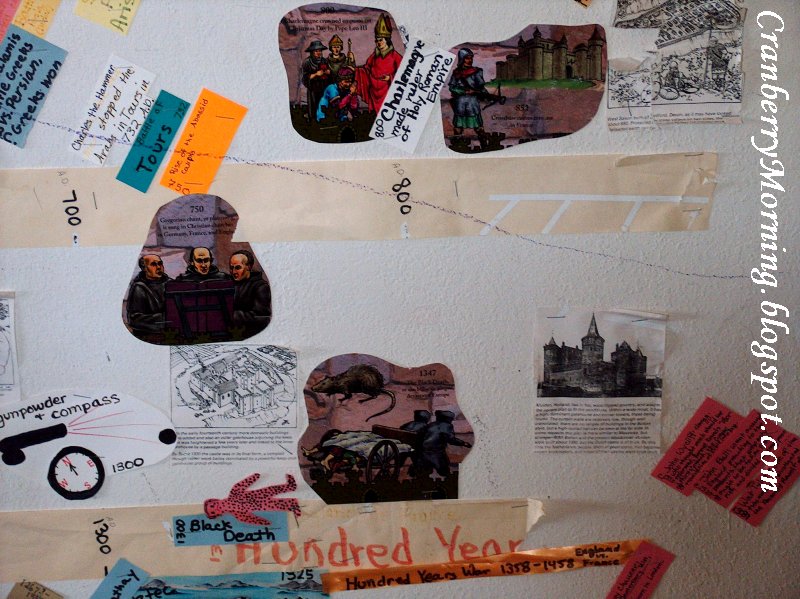

You can see that the timeline was pretty beaten up by the time our homeschooling years were over. These photos were taken after the homeschooling years, just before I reluctantly removed the timeline from the walls. Of all the objects I used for homeschooling, the timeline we'd made ourselves was the most difficult to part with. At least I have the photos, as long as Carbonite doesn't let me down.


I think some tags fell off this one.


The colored ribbons were stapled from one date to another to indicate the years covered by the reign of that particular monarch.


As I said before, these are not in order. But you will notice that in the years B.C., the dates on the adding machine tape were much closer together than they were between A.D. 1500 and A.D. 1600, for example. We had a lot more information for that time period and needed more space in which to place our pictures and tags. Still, once we went to a wider spacing, we kept that uniform for the remainder of the timeline.


Evidently that poor guy lost his right foot during the Plague that struck London in 1665. A plague and a fire. Why is this making me want to visit England again??

Yes, we did study American history, and those lines ran beneath this timeline, concurrently, so that you could see, for example, what was going on in the world at the time that Jamestown Colony was being established.

Aside:  When Jamestown was established, by the way, Pandy Inn in Dorstone, Herefordshire, had already been a free house for 500 years - and still is. But that wasn't on our timeline.

Pandy Inn, Twelfth Century Free House
Dorstone


Did you notice with what little encouragement my brain turns to England?? It's pathetic, isn't it!

By the way, it's a great idea to make a timeline even if your kids aren't in school at home. It's a fun project for everyone involved, it's inexpensive, and it's a very effective learning tool.
***


'Southern Magnolia'
Natural, Handcrafted Vegan Luxury Soap
Buy Five, Get One FREE Sale

now through March 21

On all our handcrafted soaps at

Photobucket


 This post may be linked to some of the following: Mop it Up Monday  and  Cure for the Common Monday and Mealtime Monday and Clever Chicks Blog Hop and Mosaic Monday  and Barn Charm and  The Marketplace  and On the Menu Monday and  Mix it up Monday and Make it Pretty Monday and   What's in the Gunny Sack and  Making the World Cuter Mondays and Make the Scene Monday and  Something I Whipped Up Monday and  Motivate Me Monday and  Making Monday Marvelous and Get Your Craft On and   You're Gonna Love it Tuesday and Creative Showcase and  Tweak it Tuesday and  Coastal Charm Tuesday and  Take a Look Tuesday and  Tasty Tuesday and Tasty Tuesday and Love Bakes Good Cakes and  Tempt My Tummy Tuesdays  and Overflowing With Creativity and Mom on TimeOut  and Adorned from Above and 3boysandadog and Trueaimeducation and Cast Party Wednesday and  We Did it Wednesday  and It's a Party at Creative Princess and Artsy Corner Thursday  and The Self-sufficient Home Acre and  I'm Lovin' it Thursday and  Mandatory Mooch   and Foodie Friends Friday and  Serenity Saturday and Get Schooled Saturday  and Inspiration Friday(ThursNite) and Vintage Inspiration Friday and Photo Friday and  A Favorite Thing Saturday and Sunny Simple Sunday and Market Yourself Monday and  Saturday Nite Special


Friday, January 18, 2013

London Underground History 150 Years Old

From UK Telegraph

First, just a reminder to stop in at my Valentine's Homemade Soap Sachet Giveaway. Don't miss out!

***
Now, on to the London Underground birthday party:

Excerpts from TFL.gov.uk:

'London Underground was formed in 1985, but its history dates back to 1863 when the world's first underground railway opened. 

'Today, London Underground is a major business with three million passenger journeys made every day, serving 275 stations and over 408 km of railway.

 The Tube - somewhere in London

'London has changed a lot since the first stretch of line - the Metropolitan, or Met - opened on 9 January 1863. The first stretch measured six kilometres (nearly four miles) and ran between Paddington (Bishop's Road) and Farringdon Street.

'To build the Met, streets along the route were dug up, tracks laid in a trench, covered with a brick-lined tunnel and the road surface replaced. Known as the 'cut and cover' method, this was quick and effective, but created as many problems as it was designed to solve. It caused congestion during construction and it was abandoned towards the end of the 19th century. By then, however, the Metropolitan was a success, stretching ever further across Middlesex, through Hertfordshire and into Buckinghamshire.

'Other companies were keen to get involved and by Christmas 1868, the Metropolitan District had opened a line between Westminster and South Kensington.

'This linked to a branch line from the original Met and some eastward extensions. These railways completed today's Circle line by 1884.'


Tube Station Sign at Westminster 

From lookandlearn.com

'Property-owners thought their buildings would fall as a result of all the excavations taking place. In fact, some of these fears may not have been groundless, for many buildings had to be shored up with timber while the work was in progress.

'Anyone visiting London during 1861 could well see the reason for people’s concern. In the vicinity of King’s Cross, gangs of workmen were furiously digging up the streets. Great yawning holes marked where the road had once been, leaving only a small area over which carriages and pedestrians had to make their way as best they could.

'Some parts of the road were closed completely to allow the men to dig their holes. Once the holes were completed, with the mud piles high on either side, much to the annoyance of pedestrians, the men started shoring the sides of the hole. Then the upper part of the holes was enclosed in a brick arch. Once this was completed, the earth was replaced over the work, the surplus earth carted away, and the road relaid so that everything looked as it had before. But there was one main difference. Eighteen metres below the new road surface lay a long tunnel that stretched between Paddington and Farringdon Street, a distance of about six kilometres.


Tottenham Court Road Tube Station
Cool, huh!

'The person chiefly responsible for this undertaking was Charles Pearson, a city solicitor. Since 1843, he had been suggesting that London should have an underground railway system. He suggested that a trial section should be constructed along the valley of the River Fleet, which had been arched over and converted into a sewer. It would use trains powered by atmospheric pressure. In spite of Pearson’s pleas the plan was never followed up, but he continued to campaign for this new form of transport.

'The idea was not, however, entirely new; for what can possibly be regarded as the first underground railway was started in 1770 at East Kenton Colliery near Newcastle-upon-Tyne. The railway, used to carry coal trucks on simple wooden tracks, consisted of a single tunnel, which can lay claim to being the first railway tunnel.'

***

And here's a great slide show about the history of the London Underground from the UK Telegraph that you won't want to miss. (Well, at least I wouldn't have wanted to miss it.)

Happy Birthday, London Underground! 


My favorite


***


P.S. Today is the last day to enter our HomemadeSoapNSuch Giveaway! Hurry. Giveaway ends tonight at midnight. Don't procrastinate and turn into a pumpkin!


'English Rose'
Homemade Vegan Soap
...and more! Check out all our handcrafted soaps at
HomemadeSoapNSuch

and at

Our ETSY Store 


This post is linked to Photo Friday


Have a great weekend, everyone! The winner of the Giveaway will be announced Monday on Cranberry Morning.

 
Photobucket

Friday, August 24, 2012

Anglophile Friday - Bath Abbey Revisited

 Bath Abbey


From BathAbbey.org:

"There has been a place of Christian worship on this site for well over a thousand years. However, the Abbey has undergone many transformations and changes during this time, and much like the city of Bath has experienced rise and falls in fortune, survived a number of major conflicts, architectural and religious reforms, and two World Wars, but still stands proudly today as an essential place for both worshippers and visitors.

"As the history of this sacred place stretches as far back as Anglo-Saxon times, there is a great deal to discover: tales of Kings and Queens, saints and sinners, as well as stories of ordinary people.


"Five Things to Know About Bath Abbey

  • Since 757 AD, three different churches have occupied the site of today’s Abbey: an Anglo-Saxon Abbey Church (757-1066), pulled down by the Norman conquerors of England; a massive Norman cathedral begun about 1090, which lay in ruins by late 15th century; and the present Abbey Church founded in 1499 but incomplete until 1611.

  • In 973 King Edgar was crowned King of all England in the Anglo-Saxon Abbey Church (as shown above). The service set the precedent for the coronation of all future Kings and Queens of England including Elizabeth II.

  • The present Abbey Church was founded in 1499 when the newly appointed, Bishop of Bath, Oliver King, is said to have a dream of angels ascending and descending into heaven, which inspired him to build a new Abbey church – the last great medieval cathedral to have been built in England.

  • After the dissolution of the monasteries in 1539 by order of King Henry VIII, the Abbey lay in ruins for more than 70 years. It wasn’t until 1616, that much of the building we see today was repaired and in use as a parish church and over two hundred years later, in the 1830s, that local architect George Manners added new pinnacles and flying buttresses to the exterior and inside, built a new organ on a screen over the crossing, more galleries over the choir and installed extra seating.

  • The Abbey as we know it is the work of Sir George Gilbert Scott, who from 1864 to 1874, completely transformed the inside of the Abbey to conform with his vision of Victorian Gothic architecture. His most significant contribution must surely be the replacement of the ancient wooden ceiling over the nave with the spectacular stone fan vaulting we see today."

 The beautiful fan vaulted ceiling of Bath Abbey


There's a lot more history of Bath Abbey to be found at Bath Abbey.org


 The East Window


 The only thing I didn't like about the Abbey
was the litter strewn about an exterior door.
Why??

The black Lab is wondering that too, and hoping that FOOD will be the next thing thrown onto the pavement.

I need to return to Bath with my new camera.


 ***

 'Frosted Apple Spice'

...and more! Check out all my handcrafted soaps at
HomemadeSoapNSuch

Have a great weekend, everyone!


Photobucket

LinkWithin

Related Posts with Thumbnails